Weird Wedding Traditions From Around the World


Key Takeaways
- Sometimes weird wedding traditions hold great importance behind them, from safeguarding the newlyweds against any bad luck to representing prosperity, strength, fertility, or family unity.
- Such unique wedding customs may seem strange to someone who is not aware of the tradition, but at the same time mean a lot to the people performing it.
- It is through such weird wedding traditions that one can see how different cultures celebrate love and marriage.
A wedding can turn out to be entirely different, depending on which part of the globe you live in. Although the act of giving rings, dressing up formally, and having family members involved are known to a lot of couples, there is an endless list of surprising wedding traditions practiced around the world.
Some people choose to have fancy ceremonies, while others involve themselves in funny games, food, unusual preparation, and some bizarre rituals. These fascinating wedding traditions do not just remain unique; they hold deep meaning. They symbolize good luck, fortune, prosperity, protection, and the duties of a married couple.
Ranging from smashing the porcelain in Germany to pouring a very odd liquid over the wedding couple in Scotland, these weird wedding traditions around the world demonstrate the diversity of ways to celebrate the start of a marriage.
How Marriage Traditions Become So Weird Sometimes
Labeling something weird depends on one’s perspective to some extent. A practice that can appear weird for a person experiencing it for the first time can be considered completely normal in the society where it has been born.
Wedding rituals have been born long before any concepts associated with the way modern people view marriage ceremonies, relationships, and celebrations emerged. Most of the rituals had to do with fertility, protection, family duties, and prosperity.
In the modern world, some rituals continue to be practiced in the same way they used to be centuries ago, but many rituals have become more symbolic. People also sometimes mix up traditions of various cultures and create unique ceremonies. That is why the element of surprise is an important part of wedding traditions.
Let’s have a look at weird wedding traditions around the world.
1. Germany: Porcelain Broken Before the Wedding
Among the more unique practices of Germany is one that is called Polterabend. Traditionally taking place prior to the wedding, it features the guests breaking porcelain dishes.
The act is deliberate in nature. Once the porcelain is broken, both the bride and groom proceed to clean the mess.
The practice is especially meaningful in relation to marriage itself. The fact that both individuals have to clean up together indicates that they will be able to tackle any troubles together. In contrast to wishing the bride and groom happiness, the custom actually demonstrates what kind of teamwork may be required during marriage.
There are other unique traditions preceding a wedding in Germany too. Among those, there are traditions in which the bride and groom have to complete various tasks together to demonstrate their ability to cooperate.
2. Scotland: The Chaotic "Blackening" Tradition
There is no wedding ceremony tradition more outrageous than the blackening ceremony of Scotland.
As tradition would have it, the couple, either just the bride, groom, or both of them, may find themselves covered in messy things such as flour, soot, syrup, and other messy substances. Friends and family members may parade the couple in the pre-wedding ceremony.
Despite the fact that it sounds like chaos on purpose, this tradition is often related to the preparation of a couple for their married life ahead. If the couple is able to get through this embarrassment, nothing else will be difficult for them to handle.
This ritual varies greatly depending on the times, and it is not performed by all couples in Scotland. However, it is one of the best-known traditions worldwide.
3. China: An Unusual Custom That Includes Tears
Not all traditions that are unusual serve the purpose of making people laugh.
One such example is found in the Tujia culture in China, where crying is traditionally an essential part of the pre-wedding ceremony, in which the bride would cry before her marriage. Traditionally, it is believed that the bride starts crying first and then other female members of her family also join her.
From the point of view of an outside observer, this unique wedding custom of crying before the ceremony seems very strange because wedding ceremonies are usually associated with joy. In this tradition, however, crying represents the expression of emotions and gratitude and the significance of leaving one’s family behind for marriage.
4. Mexico: Dancing Floor Becomes the Gift Exchange
While wedding parties are mostly characterized by dancing, in some weddings held in Mexico, dancing is also a way of making financial contributions to the new couple.
This money dance entails paying to have the chance to dance with the bride or the groom, usually by attaching money to their outfits. The money is useful in meeting the needs of the honeymoon or any other costs associated with the wedding. This tradition is seen in different forms in various cultures around the world.
While at first sight this may seem like a weird party activity, it actually reflects the reality of the situation. Instead of coming with a gift, people come and participate in the event while assisting the couple in starting their marriage.
Also Check: Custom Wedding Rings: Create a Ring That Feels Truly Yours
5. India: The Groom’s Shoes Turn Into a Trophy
Weddings in India feature elaborate rituals and many traditions of the family, but one entertaining ritual happens after the removal of the groom’s shoes at the entrance to the place of the wedding.
The bride's sisters, cousins, or any other female members of her family can take the shoes away from the groom and hide them. As a result, the groom or his relatives should bargain with them to get back the shoes.
Thus, the seemingly trivial action becomes part of an entertaining family game, while providing the two parties of the wedding with an occasion for communication.
The ritual proves how some wedding rituals unite symbolic actions with entertainment and involve the relatives in the event actively.
6. Kenya: A Surprise Blessing
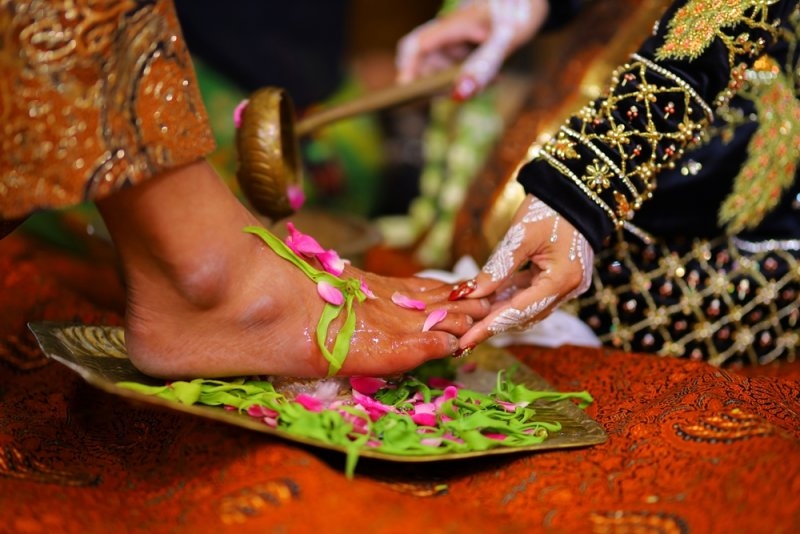
In the culture of the Maasai, there is an interesting traditional wedding practice that could be surprising for outsiders. For example, one custom includes a ritual of spitting by the bride's father onto her head and breasts as a form of blessing before she departs from home to start family life.
Though spitting in most cultures is associated with negative connotations, it is quite different in this case since it represents blessings.
It is yet another illustration of why the context is important when investigating weird wedding traditions. What in one culture symbolizes something could mean an entirely different thing in another.
7. Nigeria: Financial Gifts at the Celebratory Event
The custom of incorporating money into wedding celebrations is common among various cultures. However, the money-spraying custom practiced in Nigeria is more energetic than others.
At the celebration, people shower the couple with money as they dance. The custom symbolizes celebration, generosity, wealth, and support of the new couple. Sometimes, the money can be collected by members of the family or appointed assistants.
Instead of giving financial gifts privately, the custom integrates generosity within the celebration. The event incorporates music, dance, family, and money blessings.
8. Spain: New Use for the Groom’s Tie
In some Spanish weddings, there is a fun custom related to the groom's tie.
After the wedding ceremony, the groom's tie is cut into pieces by friends, and the pieces are sold or auctioned off to the guests. The money received from such an activity is believed to be lucky for the new couple's future.
This tradition, similar to the Indian shoe stealing tradition, makes use of a common wedding item as a source of entertainment for the guests.
9. Norway: Crown as Protection Against Evil Spirits
The brides in Norway have always worn a crown made of silver or gold that had small bells attached to it. The bells create a tinkling sound while the bride walks.
It is thought to keep evil spirits away from the bride when she starts her marital journey. While this crown may seem like a fancy part of the bride’s jewelry, it has more than just aesthetic value.
This custom is one of the amazing ways of understanding the meaning behind a wedding outfit.
10. Czech Republic: Putting a Baby on the Bed of Newlywed Couples
There are several unique wedding customs practiced in the Czech Republic that include putting a baby on the bed of the soon-to-be-wed couple. This custom symbolizes fertility and having kids.
However, the custom does not stop at that. On their wedding day, the guests can throw rice, peas, and lentils on the couple, which have something to do with fertility and abundance.
Although the practice of putting babies on the couple's bed may seem strange to those who do not know about this custom, it means good fortune in the cultural context.
Must Read: Wedding Registry Sites for Couples Planning to Marry in 2026
11. Niger: A Camel Dance during the Reception
As part of the wedding festivities in Niger, a tradition that is definitely not easy to forget includes the camel dance.
The camel will be decorated and will be dancing in time to the music of drums, as the guests come to watch and participate in the dance. This odd spectacle transforms the celebration into a fun and communal activity.
This is one of the few examples of wedding traditions which are not based on any ritual or symbol of the wedding itself, but on entertainment.
When Weddings Include Challenges
Some cultures feature traditions where the couple faces a specific challenge.
In the German tradition of breaking porcelain, the couple has to tidy up afterward. In Scotland, there is a tradition known as the blackening, which entails going through an embarrassing ritual. In other traditions, the couple has to carry out certain activities as a team.
At first sight, such traditions may appear quite bizarre against the backdrop of the current wedding with lots of photos, speeches, and dancing. However, the message behind these weird wedding traditions proves to be rather similar – marriage is a team effort.
What These Customs Reveal about Marriage
While analyzing the many unique wedding customs in existence today, a few common trends emerge.
Luck and Protection
Several customs have the function of either shielding the couple from bad luck or ensuring that good luck follows the union.
Prosperity and Support
Money dances, money throwing, money giving, and other economic customs are all about the support the community can give to the new couple.
Family and Community
The marriage ceremony is not just about the people who are getting married; often, family members and even other relatives have specific roles.
Partnership
The funniest customs are usually those that teach partnership. When the couple needs to do something together, it shows their ability to cooperate through life's difficulties.
Can Couples Use Unusual Traditions in Their Modern Wedding Ceremonies?
Certainly, but only as long as respect is given to the tradition.
If the couple decides to use some cultural tradition, then it would be wise for the couple to first learn about the background of the tradition rather than just picking up something that will look different in photos. The inclusion of relatives who will be involved in that tradition can add more significance to the practice if it comes from the background of one of the partners.
For multicultural couples, combining the best from different cultures is a good idea to organize the wedding ceremony, which would reflect both families.
The aim is not to gather the strangest customs available. The objective is to select those that mean something.
Conclusion
Weird wedding traditions around the globe have shown that there has always been more than one way to celebrate marriage. What at first seems peculiar will eventually give way to an appreciation for the values of family, good fortune, abundance, fortitude, and companionship that cut across cultures in unexpected ways.
From rowdy Scottish parties to mystical German traditions and fun wedding customs in Asia, Africa, Europe, and Latin America, these wedding customs are evidence of the unique way people incorporate personality into their lives’ most important events.
Finally, the best wedding may well be the one where the traditions and the conventional are both tossed aside in favor of the couple’s personal story.
FAQs
Why Is There So Much Difference in the Wedding Rituals Between Cultures?
The wedding rituals are developed according to a number of factors present in the society, such as history, religion, family structure, belief systems, and others. With time, rituals take unique forms in different societies.
Do Unusual Wedding Traditions Still Exist?
Many of the unusual wedding traditions exist even today, although in some modified forms. Some couples choose to follow their traditional forms, whereas others prefer a modified form of them. It must be kept in mind that not all traditions are followed universally by a particular culture.
Can Couples of Different Cultures Combine Different Wedding Traditions?
Certainly. The couple belonging to different cultures can use important aspects of each tradition. It is important to discuss the importance of each ritual before adopting it.
Why Do People Have Wedding Traditions?
The meaning of wedding traditions could be love, commitment, family unity, success, luck, or entering a new stage in life. This all depends on the culture and tradition.
How Should Couples Select a Cultural Wedding Tradition?
It would be better for couples to think about some traditions that mean something for their family or for the whole culture, but not those that seem strange only because of their uniqueness.
This content was created by AI


-1780483432-r.jpeg&w=700&h=400&zc=1&cc=ededed&s=1&a=t)